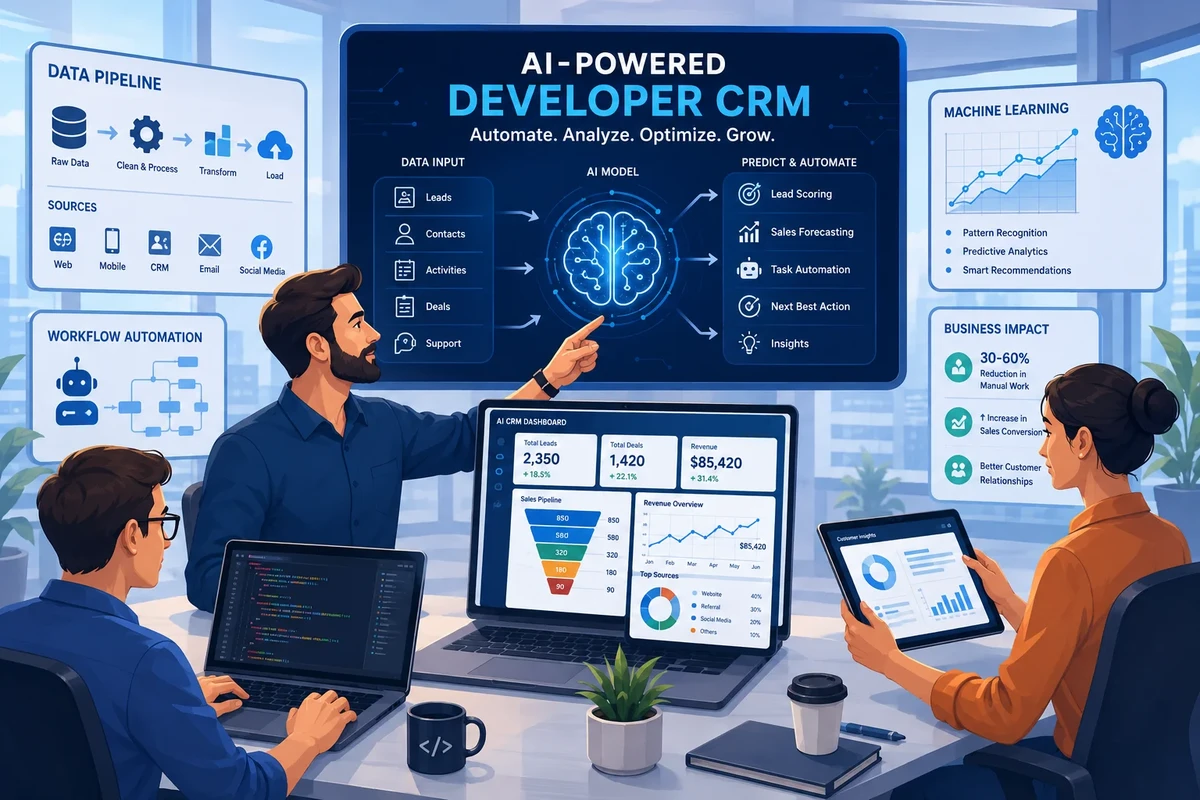
By 2026, enterprise CRM systems have transitioned from passive databases that record customer activity into autonomous operational engines engineered to execute end-to-end sales and service workflows. Instead of relying on human representatives to manually log calls, qualify leads, and update deal pipelines, autonomous CRMs deploy collaborative software agents that read real-time buyer signals across disparate enterprise databases, resolve customer inquiries without human intervention, and proactively drive revenue progression.
Enterprise software executive Amit Zavery captured this structural transition directly:
“Traditional CRM was built to record. Autonomous CRM is built to act.”
For revenue operations leaders, chief information officers, and sales enablement directors, this architectural pivot marks the definitive departure from the historical premise of customer relationship software. For three decades, enterprise platforms functioned as retrospective filing systems—originating as digital rolodexes in CRM 1.0, and evolving into centralized cloud databases driven by form-based workflow automation in CRM 2.0. Across both operating models, the system remained entirely reliant on manual employee data entry and swivel-chair coordination across disconnected applications.
The rise of CRM 3.0 replaces manual data entry with proactive agentic execution. Rather than prompting human representatives to summarize meetings or draft outreach emails, autonomous CRM networks ingest behavioral signals across customer communication channels, enterprise resource planning platforms, and internal operational data stores to orchestrate revenue workflows directly. Software agents take on the role of digital workers, executing complex business logic within strictly governed enterprise parameters.
Autonomous Action Replaces Passive Record-Keeping in 2026
In 2026, AI-powered CRM shifts from passive systems of record to autonomous systems of action. Rather than requiring human data entry, autonomous CRMs use multi-agent architectures and unified semantic data to sense buyer signals, orchestrate omnichannel workflows, and execute end-to-end resolutions across sales and customer support without manual handoffs.
The historical limitations of CRM 1.0 and CRM 2.0 created persistent operational friction within enterprise sales organizations. Sales representatives historically spent significant portions of their workweeks manually logging call notes, manually adjusting opportunity stages, and reconciling pipeline entries across fragmented tools. This administrative burden reduced active selling time and introduced systemic data latency, leaving leadership to make forecasting decisions based on outdated, incomplete pipeline records. In contrast, CRM 3.0 establishes an operational model where the software continuously senses intent, formulates execution plans, and performs necessary operational transactions without requiring human prompts.
Enterprise technology leaders recognize the urgency of this transition. Data published by Creatio indicates that 86% of C-level decision-makers view AI agents as central to their strategic goals over the next two to three years. Burley Kawasaki, Global VP of Product Marketing and Strategy at Creatio, outlined the broader competitive implications of this architectural shift:
“Agentic automation is not simply another technology trend. It is the foundation of how enterprises will innovate, compete, and grow in the AI Economy.”
This executive alignment reflects the operational impact of autonomous systems that act across systems rather than confining users to a single interface. In enterprise customer support and sales operations, agentic CRM architectures resolve complex cases end-to-end. By analyzing live support tickets, historical purchase records, and real-time operational status, autonomous agents resolve customer inquiries directly. Instead of forcing representatives to toggle between five distinct software applications to fulfill a client request, autonomous software agents coordinate across the technology stack to complete transactions, update relevant databases, and record comprehensive audit logs in real time.
How Multi-Agent Architectures Coordinate Enterprise Workflows
Modern autonomous CRM implementations depart from monolithic large language model designs in favor of specialized multi-agent architectures. In enterprise production environments, relying on a single generalized language model to simultaneously manage lead scoring, contractual term verification, supply chain coordination, and customer dispute resolution creates cognitive bottlenecks and increases hallucination risks. Enterprise platforms instead deploy networks of specialized autonomous agents, with each agent engineered to excel at a distinct operational capability while maintaining continuous state synchronization across shared protocols.
Preserving Context via Model Context Protocol and Agent-to-Agent Handoffs
The primary technical challenge in multi-agent orchestration involves preserving conversational and operational context across organizational handoffs. To solve this, enterprise platforms support open communication standards, specifically the Model Context Protocol (MCP) and Agent-to-Agent (A2A) protocols. Model Context Protocol standardizes how autonomous agents securely access enterprise tools, database schemas, and structured business records, ensuring that an agent operating within a sales pipeline reads the exact same semantic data definitions as an agent managing customer support tickets.
Concurrently, Agent-to-Agent (A2A) protocols enable real-time state sharing and task delegation between autonomous agents. When an inbound account signal requires cross-functional coordination, the originating agent passes the operational session, historical context, and current execution state to a secondary specialist agent without data loss. In an autonomous sales operations workflow, specialized agents summarize customer communications, generate pre-meeting research briefs, identify missing contact fields, and verify product inventory in connected ERP databases before recommending appropriate commercial actions. Representatives retain strategic commercial oversight while the multi-agent network autonomously handles administrative and operational coordination.
Unifying Fragmented Touchpoints with Semantic Customer Embeddings
Multi-agent coordination requires a real-time, unified data foundation to operate without error. Enterprise customer touchpoints are historically fragmented across incompatible data schemas, including email exchanges, live chat transcripts, support tickets, web analytics, and financial billing systems. Traditional relational databases struggle to unify these unstructured, time-series interactions into actionable buyer intelligence.
To overcome this data fragmentation, academic researchers Eva Ascarza from the NYU Stern School of Business and Ayelet Israeli from Amazon documented the construction of Semantic Customer Embeddings. This technique establishes a standardized mathematical representation of customer behavior through a three-step integration process:
First, foundation large language model embeddings initialize item representations across diverse customer touchpoints. This step establishes a common semantic baseline for customer actions, including rare, uncataloged, or newly observed behavioral events that conventional tabular models fail to interpret.
Second, these baseline semantic representations are adapted using the organization’s proprietary customer behavioral data. This fine-tuning process aligns generalized language comprehension with the specific purchasing patterns, product taxonomies, and operational lifecycles of the enterprise.
Third, the system aggregates these adapted representations across every historical and real-time touchpoint into a unified customer embedding. Because this composite embedding directly reflects underlying customer intent, autonomous agents can accurately detect subtle churn risks, predict expansion opportunities, and execute timely cross-functional interventions across connected enterprise software systems.
Choosing Between Copilots, Autonomous Agents, and Multi-Agent Teams
Selecting between CRM AI models depends on task scope and governance requirements. Copilots assist human representatives with drafting and research while maintaining manual control; single autonomous agents execute contained, repetitive operational processes; multi-agent networks eliminate departmental silos by coordinating end-to-end customer workflows across CRM, ERP, and customer support databases.
Enterprise revenue operations leaders must establish precise delegation boundaries across the three operating tiers of CRM artificial intelligence. Applying full multi-agent autonomy to low-complexity tasks introduces unnecessary architectural overhead, while restricting complex, cross-departmental operations to assistive copilots fails to address core enterprise efficiency bottlenecks.
Operational Tier |
Core Mechanism |
Human Oversight Level |
Primary CRM Use Case |
Target Business Impact |
|---|---|---|---|---|
Copilots (Tier 1) |
Assistive prompt-and-response interfaces embedded within application sidebars |
Continuous human control; 100% manual review and execution |
Email drafting, call transcription summarization, account research |
Accelerates individual task completion; reduces manual drafting time |
Autonomous Single Agents (Tier 2) |
Goal-directed agents executing discrete API calls and structured logic |
Exception-based human oversight; automated execution within bounded limits |
Inbound lead qualification, meeting scheduling, tier-1 support resolution |
Eliminates routine administrative workflows; provides continuous 24/7 responsiveness |
Collaborative Multi-Agent Systems (Tier 3) |
Orchestrated agent networks communicating via MCP and A2A protocols |
Policy-governed autonomy; deterministic guardrails and automated kill switches |
Cross-platform deal orchestration, ERP inventory checks, omnichannel renewals |
Dismantles operational silos; reduces combined software licensing costs up to 50% |
The operational maturity of these tiers was demonstrated at ServiceNow’s Knowledge 2026 event, where the organization showcased autonomous AI agents sensing, deciding, acting, and securing workflows across the customer lifecycle. Demonstrating real-world scale, ServiceNow reported that 3,000 customers have deployed agentic AI capabilities, with more than 200 distinct agentic use cases operating live in production enterprise environments.
This structural evolution fundamentally alters the economics of enterprise software procurement. Industry analyses indicate that deploying autonomous agentic workflows across customer support and sales operations unlocks a potential 50% reduction in combined CRM and ERP licensing expenses. As collaborative software agents take over back-office operational tasks and routine cross-database data entry, organizations require fewer high-tier, per-seat human administrative licenses to manage enterprise record systems.
Quantifying 2026 Operational Gains Across Sales and Support
Enterprise deployments of autonomous CRM in 2026 demonstrate that organizational performance is measured by operational throughput and revenue velocity rather than feature novelty. Industry reporting by Creatio notes that enterprise leaders have moved past exploratory experimentation, evaluating AI CRM implementations strictly on measurable cost reductions, time savings, and commercial conversion uplifts.
Organizations implementing autonomous agentic CRM workflows report concrete efficiency and commercial improvements across both front-office sales operations and contact center environments:
- Dramatic Resolution Acceleration: Companies deploying autonomous AI report up to an 87% reduction in average customer resolution times, accompanied by an overall 28% improvement in issue resolution speed.
- Enhanced First-Contact Success: Implementations show a 19% increase in first-contact resolution rates, as autonomous agents access real-time diagnostic telemetry to resolve customer issues without escalations.
- Substantial Contact Center Labor Recovery: Contact center representatives save an average of 1.2 hours per day when supported by autonomous systems, shifting recovered capacity toward complex customer relationship retention.
- Autonomous Omnichannel Containment: Autonomous agents resolve up to 40% of inbound customer questions completely across chat, email, voice, and WhatsApp without requiring human employee intervention.
- Sales Data Entry Elimination: At enterprise implementation scale, documented results from XYZ Corp demonstrate a 65% reduction in manual data entry by sales representatives following autonomous CRM integration.
- Lead Conversion Expansion: Operational automation at XYZ Corp drove a 40% increase in lead conversion rates by ensuring instantaneous qualification and follow-up.
- Universal Prioritization Consensus: A decisive 98% of sales teams utilizing AI report that the technology measurably improves lead prioritization, ensuring reps focus on high-probability opportunities.
- Higher Quota Attainment: Industry research reveals that businesses integrating generative AI into their CRM operations are significantly more likely to exceed their established sales targets.
- Proactive Top-Line Revenue Lift: Deploying proactive customer engagement workflows that deliver context-aware interactions at the optimal moment produces a 5-8% increase in gross revenue and a 15-20% uplift in customer satisfaction scores.
- Broad Customer Satisfaction Gains: Across enterprise service deployments, organizations utilizing proactive automated outreach report an 81% improvement in overall customer satisfaction ratings.
These performance benchmarks illustrate why enterprise revenue leaders view agentic architectures as essential infrastructure. By automating data reconciliation and operational workflows across interconnected systems, organizations eliminate execution latency and establish continuous commercial responsiveness.
Why Most AI CRM Rollouts Stall and How to Enforce Guardrails
Despite the commercial potential of autonomous CRM architectures, enterprise adoption faces a stark structural contradiction. Market data reveals that while a majority of organizations plan to implement AI-powered CRM systems, only 12% of CRM users actively utilize AI tools within their daily operational workflows. This stark implementation gap highlights the failure of early artificial intelligence initiatives across enterprise sales organizations.
This adoption stall stems primarily from the architectural limitations of bolted-on AI tools deployed over fragmented, unmanaged legacy databases. When vendors attach generative chat interfaces to disconnected data repositories filled with duplicate accounts, outdated opportunity stages, and incomplete customer profiles, the underlying models produce inaccurate recommendations and hallucinated customer summaries. Sales representatives quickly lose confidence in the technology and abandon the tools in favor of manual spreadsheets and external documents.
Deploying autonomous agents without deterministic boundaries creates severe operational liabilities. Customer service AI specialist Stefan Rademacher identified the central governance vulnerability of unconstrained agentic execution:
“In customer service, the hard part often isn’t getting an agent to complete a workflow — it’s deciding when it should stop and hand off, especially when customer records conflict or a request falls outside policy.”
Operational Governance Warning: Autonomous Agent Exception Protocols
Deploying autonomous agents without programmatic policy boundaries risks commercial error, regulatory non-compliance, and customer churn. Revenue operations leaders must establish strict architectural guardrails to maintain operational control:
- Deterministic Authorization Thresholds: Program strict computational boundaries that prevent autonomous agents from offering unauthorized contract discounting, extending payment terms, or modifying legal liabilities without verified executive approval.
- Automated Data Conflict Halts: Configure immediate execution pauses when customer records conflict across operational databases—such as discrepancies between CRM billing profiles and ERP accounts—automatically routing the transaction to human operators.
- Policy Boundary Escalation: Implement structured exception paths that instantly halt autonomous execution when an inbound customer request falls outside standard operational policy, preventing unpredictable agent improvisations.
- Auditable Decision Logging: Maintain comprehensive, tamper-evident logs of every agent reasoning step, data access event, and programmatic handoff to support internal governance audits and meet regulatory standards for automated decision systems.
Establishing these deterministic controls resolves the underlying distrust that causes reps to abandon AI tools. When software agents operate within strictly verifiable boundaries and automatically defer ambiguous edge cases to human specialists, enterprise teams safely integrate autonomous agents into critical revenue workflows.
A Phased Implementation Roadmap for Autonomous CRM Deployment
Modernizing enterprise CRM infrastructure does not require a disruptive, all-at-once replacement of existing core systems. Technology research from Gartner indicates that 80% of generative AI business applications will be developed on existing enterprise data management platforms by 2028. As the global CRM software market expands toward a projected $128 billion valuation by 2028—driven by a 28% compound annual growth rate across the AI-CRM segment—enterprise IT and RevOps leaders should deploy autonomous capabilities through a structured, phased roadmap.
- Phase 1: Data Remediation and High-Value, Low-Risk Agent Deployment: The initial phase focuses on establishing data hygiene across core customer repositories. Revenue operations teams audit legacy data pipelines, resolve duplicate records, and standardize customer identifiers across sales, support, and billing databases to ensure real-time data reliability. Organizations then deploy a single high-value, low-risk autonomous agent, such as an inbound sales qualification agent. This agent qualifies inbound leads based on deterministic criteria while human representatives retain direct approval over pipeline stage transitions and customer assignments.
- Phase 2: Workflow Automation and Predictive Analytics Integration: As outlined by Chaviva Gordon-Bennett on the monday.com Blog, completing core workflow automation and predictive analytics typically spans an 8-12 week timeframe. During this window, enterprises automate repetitive operational processes, including post-call data updates, meeting brief preparation, and automated scheduling. Predictive scoring models ingest historical conversion data to rank opportunities, eliminating manual administrative burden and demonstrating clear time-savings to field representatives.
- Phase 3: Multi-Agent Enterprise Orchestration: The final phase expands deployment into collaborative multi-agent architectures that span the entire customer lifecycle. Reflecting this architectural evolution, modern agentic platforms are gaining notable industry recognition; for instance, Rox, profiled by Leah Clapper, was named the Only Visionary in the 2026 Gartner® Magic Quadrant™ for its agentic CRM framework. In this phase, enterprises connect autonomous sales, support, and ERP agents via Model Context Protocol and Agent-to-Agent protocols. These agents autonomously manage end-to-end customer journeys—detecting churn indicators, validating real-time product inventory in ERP systems, and executing contract renewals within deterministic corporate policies.
- Phase 1: Data Remediation and High-Value, Low-Risk Agent Deployment (Weeks 1–6): The initial phase focuses on establishing data hygiene across core customer repositories. Revenue operations teams audit legacy data pipelines, resolve duplicate records, and standardize customer identifiers across sales, support, and billing databases to ensure real-time data reliability. Organizations then deploy a single high-value, low-risk autonomous agent, such as an inbound sales qualification agent. This agent qualifies inbound leads based on deterministic criteria while human representatives retain direct approval over pipeline stage transitions and customer assignments.
- Phase 2: Workflow Automation and Predictive Analytics Integration (Weeks 7–16): As outlined by Chaviva Gordon-Bennett on the monday.com Blog, completing core workflow automation and predictive analytics typically spans an 8-12 week timeframe. During this window, enterprises automate repetitive operational processes, including post-call data updates, meeting brief preparation, and automated scheduling. Predictive scoring models ingest historical conversion data to rank opportunities, eliminating manual administrative burden and demonstrating clear time-savings to field representatives.
- Phase 3: Multi-Agent Enterprise Orchestration (Weeks 17–24+): The final phase expands deployment into collaborative multi-agent architectures that span the entire customer lifecycle. Reflecting this architectural evolution, modern agentic platforms are gaining notable industry recognition; for instance, Rox, profiled by Leah Clapper, was named the Only Visionary in the 2026 Gartner® Magic Quadrant™ for its agentic CRM framework. In this phase, enterprises connect autonomous sales, support, and ERP agents via Model Context Protocol and Agent-to-Agent protocols. These agents autonomously manage end-to-end customer journeys—detecting churn indicators, validating real-time product inventory in ERP systems, and executing contract renewals within deterministic corporate policies.
By executing this structured deployment model, enterprise organizations modernize their revenue operations safely. Grounding autonomous agents in unified enterprise data and deterministic governance ensures sustained operational adoption, lower software overhead, and accelerated revenue execution.
FAQ
What is the core difference between a CRM copilot and an autonomous AI agent?
Copilots assist human representatives with task-level acceleration like email drafting and meeting summarization while preserving manual user control. In contrast, autonomous agents execute multi-step operational workflows independently, making contextual decisions and resolving end-to-end customer journeys across connected systems without manual rep intervention.
How do multi-agent CRM systems prevent hallucinated commitments and pricing errors?
Enterprises enforce deterministic boundaries, strict authorization thresholds, and structured exception handoff protocols like Model Context Protocol. When customer records conflict or an inbound request exceeds corporate policy, the agent automatically halts execution and escalates the record to human oversight rather than improvising terms.
Why do only 12% of enterprise users actively utilize AI CRM features despite high expectations?
While 81% of organizations plan AI CRM adoption, only 12% actively integrate AI tools because most vendors bolt AI features onto fragmented legacy databases. Without unified real-time data hygiene and semantic customer representations, agents deliver unreliable outputs, causing enterprise reps to abandon the tools.
How does autonomous AI impact enterprise CRM and ERP software licensing costs?
Autonomous CRM systems significantly decrease enterprise reliance on traditional per-seat operational software licenses. Organizations deploying collaborative agentic workflows across customer support and sales operations report potential licensing cost reductions of up to 50% across integrated CRM and ERP software stacks.