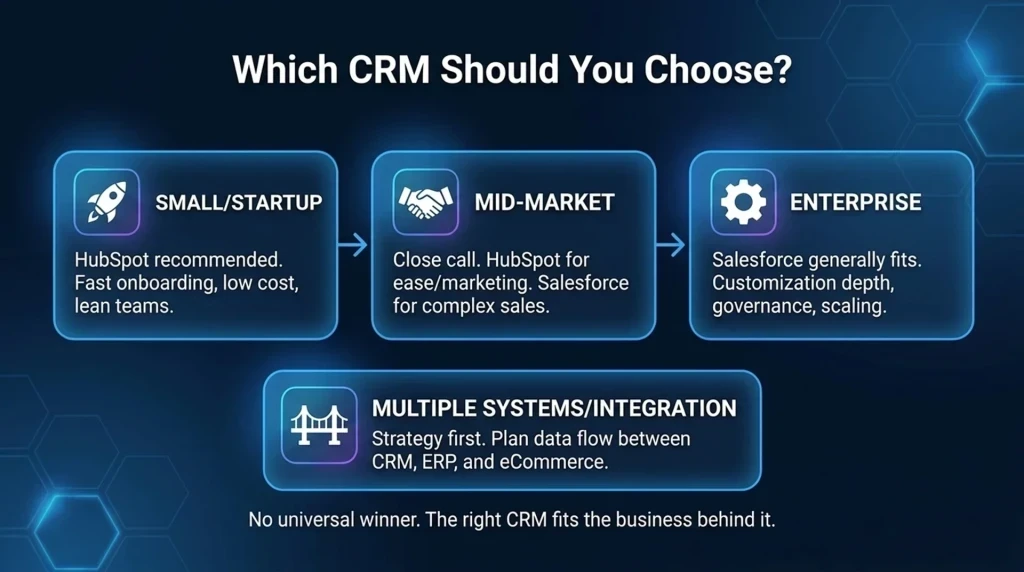
No single enterprise CRM suits every enterprise in 2026: Salesforce Sales Cloud remains the standard for massive, highly customized ecosystems requiring deep third-party app access; Microsoft Dynamics 365 leads for enterprises anchored in Microsoft ERP and Azure infrastructure; HubSpot Sales Hub Enterprise delivers the highest user adoption and unified revenue attribution; and Creatio provides the fastest workflow agility through no-code architecture.
As industry analysts observe, enterprise CRM selection is a business-architecture decision, not a software purchase: total cost of ownership, integration and governance outweigh feature lists. Enterprise technology leaders are shifting capital away from scattered point-solution subscriptions toward unified data fabrics. Industry observers note that platform consolidation is the dominant 2026 trend: enterprises are replacing fragmented point-solution stacks with unified platforms to cut costs and unify customer data. Evaluating CRM platforms in 2026 demands auditing systemic integration overhead, compliance boundaries, and ongoing administrative labor rather than scoring vendor feature checklists.
Enterprise CRM Platform Verdicts by Operational Profile
In 2026, enterprise CRM selection hinges on operational architecture: choose Salesforce for massive customization and extensive third-party app ecosystems; Microsoft Dynamics 365 for deep Microsoft ERP and Office stack alignment; HubSpot for high user adoption and unified revenue attribution; and Creatio for no-code workflow flexibility at lower baseline seat pricing.
Selecting an enterprise platform requires aligning technical governance with organizational maturity. As Smotly emphasizes, the right CRM is not the one with the most features in a brochure. It is the one that aligns with your data model, your information system, your governance constraints, and your ability to get teams to adopt it. When architectural alignment is neglected, commercial execution suffers immediately. As CRM Force warns, the best CRM is the one your sales team will actually use. An enterprise platform that goes unloved is a liability, not an asset.
- Salesforce Sales Cloud: Best suited for multinational organizations with dedicated development teams and complex, non-standard business logic. Salesforce accommodates intricate multi-subsidiary governance, complex custom object hierarchies, and specialized sales motions. Organizations selecting Salesforce commit to sustaining a dedicated engineering and administrative footprint to maintain system health.
- Microsoft Dynamics 365 Sales: The primary architecture for organizations operating on Microsoft Dynamics 365 Finance, Supply Chain Management, Azure, and Microsoft 365. Dynamics 365 eliminates data synchronization delays across commercial and back-office financial teams through native Dataverse connectors, while accommodating enterprises that mandate hybrid or on-premise infrastructure hosting.
- HubSpot Sales Hub Enterprise: The definitive choice for mid-market and enterprise commercial teams prioritizing rapid deployment, high daily active usage, and unified marketing-sales-service reporting. Operating on a single unified code base and data layer, HubSpot minimizes change-management friction and avoids the administrative bloat that plagues legacy CRM deployments.
- Creatio: The ideal architecture for operational teams requiring continuous process modifications without ongoing software development sprints. Utilizing a composable no-code design through Creatio Business and AI Studio, Creatio enables operations leaders to assemble custom process workflows and alter business rules without altering the underlying code base.
True Total Cost of Ownership Beyond the Base Seat License
Procurement teams regularly underestimate the cash outflows required to sustain enterprise CRM environments over three- to five-year lifecycles. Smotly points out that publisher prices change regularly and depend on contracts. For a serious decision, compare the TCO 3-5 years, not just the price per seat. While published entry-level tiers appear manageable, realized total cost of ownership expands substantially once data modeling, third-party middleware, sandbox environments, and ongoing systems administration are accounted for.
Budget Warning: Quoted seat licenses frequently represent less than half of realistic enterprise platform spend. Contract reviews must factor in annual developer retainers, mandatory onboarding fees, sandbox environments, and token consumption surcharges before establishing final budget approvals.
The operational reality of 50-person commercial teams reveals stark financial divergences across leading vendors. As detailed by CRM Force, a 50-person sales team deploying Salesforce Enterprise incurs a realistic annual total cost of ownership between $120,000 and $200,000 once licensing and required administrative consulting are calculated. The same team size deploying Microsoft Dynamics 365 requires an annual operating commitment between $46,800 and $80,000 for licensing alongside partner services. Conversely, deploying HubSpot Professional for a 50-person team incurs between $54,000 and $72,000 per year, driven by lower ongoing administrative demands.
Platform |
Base Enterprise Seat Price |
Realistic 50-Person Annual TCO |
Integration Ecosystem |
Primary Architectural Advantage |
|---|---|---|---|---|
Salesforce |
$175 USD/user/month (Sales Cloud Enterprise) |
$120,000–$200,000 USD/year |
6,000+ AppExchange applications |
Unconstrained custom object data modeling and deep programmatic extensibility |
Microsoft Dynamics 365 |
$105 USD/user/month (Sales Enterprise) |
$46,800–$80,000 USD/year |
Native Azure, Power Platform, and Microsoft 365 services |
Direct ERP alignment and available on-premise deployment infrastructure |
HubSpot |
$150 USD/seat/month (Sales Hub Enterprise) |
$54,000–$72,000 USD/year (Professional baseline) |
More than 2,000 integrations |
Rapid operational adoption, native attribution, and low administrative friction |
Creatio |
$75 USD per user/month (Creatio Business and AI Studio) |
Starts at $75 USD per user/month |
Composable application hub and open REST APIs |
Visual no-code process composition and rapid workflow adaptation |
Platform |
Base Enterprise Seat Price |
Realistic 50-Person Annual TCO |
Integration Ecosystem |
Primary Architectural Advantage |
|---|---|---|---|---|
Salesforce |
$175 USD/user/month (Sales Cloud Enterprise) |
$120,000–$200,000 USD/year |
6,000+ AppExchange applications |
Unconstrained custom object data modeling and deep programmatic extensibility |
Microsoft Dynamics 365 |
$105 USD/user/month (Sales Enterprise) |
$46,800–$80,000 USD/year |
Native Azure, Power Platform, and Microsoft 365 services |
Direct ERP alignment and available on-premise deployment infrastructure |
HubSpot |
$150 USD/seat/month (Sales Hub Enterprise) |
$54,000–$72,000 USD/year (Professional baseline) |
More than 2,000 integrations |
Rapid operational adoption, native attribution, and low administrative friction |
Creatio |
$75 USD per user/month (Creatio Business and AI Studio) |
$45,000–$65,000 USD/year |
Composable application hub and open REST APIs |
Visual no-code process composition and rapid workflow adaptation |
The comparative data highlights how software packaging models directly influence operational margins over multi-year cycles. Buyers must evaluate contract floors alongside seat pricing, as baseline licenses scale sharply when moving into enterprise tiers.
Licensing Tiers versus Realized Implementation Footprints
Base licensing tiers published on vendor pricing pages often obscure the entry points required for enterprise governance. Pricing data compiled by Itransition shows that while Salesforce Sales Cloud Starter suite begins at $25 USD/user/month, its complete Sales CRM equipped with built-in AI capabilities climbs to $550 USD/user/month. Similarly, Microsoft Dynamics 365 Sales core functionality starts at $65 USD/user/month, while its top-tier configuration with advanced sales intelligence, automation, and agentic insights costs $150 USD/user/month.
Published enterprise pricing reflects similar baseline tiers. Published enterprise rates list Salesforce Enterprise starting at $175 USD/user/month, Dynamics 365 Sales Enterprise at $105 USD/user/month, and HubSpot Sales Hub Enterprise at $150 USD/seat/month (which requires mandatory onboarding fees, with full suite enterprise packages starting at 3,300 EUR (about $3.7 thousand) per month). Creatio Enterprise, covering Creatio Business and AI Studio, begins at $75 USD per user/month. As detailed in Everest Group’s 43-page research report, Enterprise Customer Relationship Management Platforms Buyers’ Guide, assessing publisher tiers against contract customization requirements prevents mid-cycle capital shortfalls.
Annual FTE and Administrative Retainer Overhead Benchmarks
Technical staffing ratios represent the largest recurring hidden expense in enterprise CRM management. Salesforce deployments operating custom Apex triggers, Visualforce pages, and complex permission sets require specialized engineering governance. Organizations deploying Salesforce enterprise tiers routinely maintain dedicated certified administrators and allocated development resources, or contract equivalent external consulting retainers to support operations.
Microsoft Dynamics 365 architectures typically rely on third-party implementation partners for custom Power Apps integration and Azure pipeline maintenance, generating steady professional services overhead. In contrast, HubSpot environments are managed primarily by sales operations generalists who build custom properties, workflows, and association rules via graphical configuration menus. By avoiding bespoke code deployments, organizations running HubSpot reallocate engineering personnel toward core customer-facing products rather than internal tool maintenance.
Integration Architecture: Connecting ERP, Billing, and Data Warehouses
Market research from Forrester reveals that CRM software sits at the operational core of enterprise workflows: nearly 70% of enterprises use CRM software to enhance customer service, 64% for B2B sales and marketing automation, and 62% for field service. Because CRM platforms process operational transactions across disparate corporate divisions, choosing a platform without a rigorous integration blueprint guarantees brittle point-to-point connections.
An Integration-First vendor selection methodology evaluates data portability, schema mutability, and API throughput limits prior to viewing vendor feature demonstrations. Enterprise architects must map the exact systems of record for customer entities, billing transactions, order fulfillment, and inventory ledgers, establishing strict synchronization frequencies and error-handling routines before contract commitment.
Decoupling Core Systems via Layered API Infrastructure
To avoid tight coupling that leaves enterprise systems vulnerable to breaking changes during vendor platform updates, enterprise architects implement a three-tier API integration design:
- System APIs: Underlying connectors that interface directly with core systems of record, including ERPs such as SAP or Microsoft Dynamics 365 Finance, relational databases, and enterprise data warehouses like Snowflake or Databricks. These APIs isolate core databases and standardize raw transactional records into canonical data objects.
- Process APIs: Orchestration layers that combine data across multiple System APIs to execute cross-departmental business logic. A Process API handles complex operational workflows such as quote-to-cash, revenue recognition, contract compliance, and customer entitlement verification across the CRM and billing engines.
- Experience APIs: Consumable presentation layers configured specifically for front-end channels, including CRM user interfaces, mobile sales applications, customer support portals, and partner extranets. Experience APIs ensure that end-user applications retrieve pre-formatted, role-filtered payloads without querying core enterprise databases directly.
Decoupling through layered APIs prevents vendor lock-in and mitigates cloud data egress penalties. When an enterprise attempts to extract tens of millions of activity rows and historical customer records from proprietary CRM models, unmonitored API rate throttling and high egress surcharges can paralyze operational transitions. Establishing dedicated schema portability guarantees and contractual egress rate caps ensures data remains an organizational asset rather than a captive vendor property.
Ecosystem Breadth and On-Premise Data Residency Constraints
Pre-built application ecosystems determine how rapidly an enterprise incorporates specialized commercial tools without custom development. Salesforce AppExchange leads the industry with 6,000+ applications, offering pre-configured packages for vertical billing, regulatory compliance, and partner management. HubSpot maintains an ecosystem of more than 2,000 integrations, emphasizing standardized plug-and-play authorization across marketing automation and sales enablement utilities.
Data residency constraints dictate platform feasibility for regulated sectors. Microsoft Dynamics 365 provides an official on-premise deployment architecture alongside cloud hosting, establishing it as a primary option for defense, banking, and public-sector organizations operating under sovereign cloud mandates or air-gapped security protocols. Open-source solutions such as Twenty provide complete data model control and self-hosted sovereignty for organizations that reject multi-tenant software models entirely. In Europe, upcoming legal mandates accelerate the necessity for compliant financial integration: electronic invoicing receipt becomes mandatory for all companies in France, and issuance becomes mandatory for large companies and ETIs on September 1, 2026, extending to SMEs on September 1, 2027. CRM billing workflows, tax calculation engines, and CPQ tools must connect with certified e-invoicing platforms to avoid statutory penalties.
Evaluating Agentic AI and Data Readiness in 2026
Agentic CRM AI requires clean, unified underlying data and governed execution layers rather than isolated chat add-ons. In 2026, enterprise buyers must audit whether AI agents—such as Salesforce Agentforce or Dynamics 365 Copilot—operate with Zero Data Retention, predictable consumption pricing, and strict role-based access control across proprietary customer data.
The enterprise CRM market has shifted rapidly from simple generative text summaries to autonomous agentic systems capable of executing cross-platform transactions. Industry analysts highlight that AI has moved from add-on to architecture: agentic AI, predictive analytics and — critically — the quality of your underlying data now shape platform choice. Autonomous agents that update deal probabilities, trigger supply chain replenishment, and draft contract amendments depend entirely on relational data accuracy. Salesmate emphasizes this operational prerequisite directly: AI capabilities only deliver value when data is clean and consistent. Poor data leads to poor outcomes.
Moving Beyond Generative Chatbots to Governed Agentic Execution
The release of agentic engines, including Salesforce Agentforce, Microsoft Copilot for Sales, and HubSpot Breeze AI, introduces new financial and governance complexities that procurement teams must address. Unlike traditional seat licenses with fixed per-user monthly fees, agentic execution relies heavily on consumption-based billing models. These structures charge enterprises per automated conversation, computational credit, or token volume. Unmonitored automated actions can quickly exhaust standard operational allowances, generating unexpected mid-term budget overruns.
Enterprise AI governance also requires strict compliance with international regulatory frameworks, including the European Union AI Act. When deploying autonomous agents across proprietary customer databases, enterprise agreements must enforce three non-negotiable protections:
- Zero Data Retention (ZDR): Contractual guarantees that vendor large language models and underlying foundation infrastructure do not store, log, or reuse enterprise prompts, pipeline data, or proprietary communications for model training.
- Prompt-Layer PII Tokenization: Automated client-side masking that strips personally identifiable information, account numbers, and sensitive commercial terms before data leaves enterprise network boundaries.
- Sub-Processor Transparency: Full technical disclosure identifying which third-party cloud hosts and model providers process corporate tokens, backed by enterprise service level agreements and audit rights.
Mandatory Empirical Scenario Testing on Proprietary Enterprise Data
Standard vendor sales demonstrations rely on pristine synthetic data environments that conceal how algorithms behave under real-world conditions. Enterprise buyers must execute empirical scenario testing using sanitized extracts of their own corporate records during proof-of-concept evaluations.
Empirical testing must challenge the platform across common organizational data anomalies, including duplicate corporate accounts, non-standard transaction currencies, conflicting contact titles, and fragmented communication histories. Subjecting candidate models to complex enterprise workflows—such as automating revenue attribution across multi-channel sales cycles or routing multi-tiered support escalations—reveals whether an agent reliably grounds actions in corporate policies or hallucinates incorrect transactional records.
Mitigating Implementation Failure Through Phased Cutover
Enterprise CRM migrations represent severe organizational friction points. Huble observes that many enterprise CRM projects in 2026 are replatforming decisions rather than first purchases — most commonly consolidating away from Salesforce or Microsoft Dynamics 365 estates that have grown expensive and fragmented. When consolidating legacy platforms, technology leaders often misdiagnose the causes of past operational friction. As Huble states plainly, most enterprise CRM failures are adoption failures, not technology failures. Change management is what converts licence spend into ROI.
Operational Risk: Direct cutovers from heavily customized legacy instances consistently produce data corruption and user rejection. Organizations that attempt monolithic transitions without parallel production testing risk multi-week pipeline blind spots and unrecoverable opportunity tracking errors.
Salesmate points out that the biggest enterprise CRM problem is not a feature shortage, but fragmentation across systems, teams, and processes. CRM failures rarely happen because of missing features. They happen because systems cannot handle complexity, data is fragmented, and teams cannot execute consistently. A disciplined migration requires a structured, multi-phase cutover plan:
- Phase 1: Canonical Data Scrubbing and Schema Normalization: Purge inactive leads, reconcile duplicate company entities, and establish standard field definitions before moving records. Migrating legacy data clutter into a new architecture guarantees low user confidence on day one.
- Phase 2: Core Pipeline Pilot Testing: Deploy the candidate platform to a single regional sales division or business unit. This team conducts daily pipeline management, quotation generation, and activity tracking in the new system while technical leads monitor API stability and synchronization latency.
- Phase 3: Parallel Operational Runs: Maintain concurrent data entry between legacy estates and the new platform for a two-week billing cycle. Compare forecast reporting, commission calculations, and pipeline health metrics across both systems to verify transaction parity.
- Phase 4: Phased Cutover and System Archival: Transition remaining divisions in scheduled cohorts, paired with structured, role-specific user enablement. Immediately convert legacy CRM instances to read-only archival databases to eliminate unauthorized dual-entry habits and curtail ongoing seat license liabilities.
Which Enterprise CRM Fits Your Architecture?
The optimal enterprise CRM selection is dictated by existing technical debt, back-office ERP architecture, internal developer capacity, and regulatory constraints. Enterprise leaders should match their operational profile to vendor capabilities using clear architectural criteria:
- Global Enterprises with Complex ERP and Development Teams: Organizations with large custom data models and substantial developer resources achieve unmatched operational tailoring through Salesforce Sales Cloud. For organizations deeply integrated with Microsoft Azure, Power BI, and Microsoft Dynamics 365 ERP, Dynamics 365 Sales provides superior native synchronization and lower overall operational overhead.
- Fast-Growing Mid-Market and Commercial Consolidators: Enterprises seeking to reduce administrative complexity, eliminate dedicated developer salaries, and unify commercial data across marketing and sales choose HubSpot Sales Hub Enterprise. Its unified platform design accelerates cross-team execution and delivers immediate visibility into revenue metrics.
- Process-Driven Organizations Demanding Rapid Workflow Agility: Operational leaders who must continuously refine business processes without queuing custom development tickets thrive on Creatio, using its no-code composable components and business process management architecture.
- Regulated and Data-Sovereign Entities: Enterprises governed by air-gapped security requirements, sovereign cloud legislation, or strict internal data control mandates choose Microsoft Dynamics 365 for its verified on-premise infrastructure options, or evaluate open-source solutions like Twenty for complete hosting independence.
To execute a defensible procurement process, enterprise procurement committees can utilize structured evaluation timelines. Independent technology advisory firm Viewpoint Analysis outlines a disciplined CRM selection methodology that progresses from initial business briefing and RFP distribution to interactive vendor sandboxes and commercial contract negotiation. Ensuring that enterprise RFPs evaluate mandatory accessibility standards—such as WCAG AA compliance, Section 508 guidelines, and the European Accessibility Act—alongside strict uptime SLA commitments guarantees that the selected CRM architecture meets organizational, legal, and operational standards over multi-year deployment horizons.
FAQ
How do 2026 agentic AI consumption models disrupt traditional seat-based CRM budgets?
Unlike fixed per-user subscriptions, agentic AI platforms like Salesforce Agentforce and Copilot meter consumption via automated action credits or token allowances. Organizations must budget for variable compute spikes alongside baseline licensing to prevent unexpected operational cost escalations.
Which enterprise CRM platforms support on-premise or hybrid hosting?
Microsoft Dynamics 365 remains the sole major tier-one enterprise CRM platform offering an official on-premise deployment option. This makes it a primary choice for highly regulated enterprises subject to strict sovereign data governance or air-gapped security mandates.
What internal FTE staffing ratio is required to support Salesforce versus HubSpot?
Salesforce implementations typically require dedicated certified administrators and developer consulting to manage ongoing custom code and object architecture ($120,000–$200,000 annual TCO for 50 seats). HubSpot generally operates efficiently with existing sales operations generalists and lighter technical overhead ($54,000–$72,000 annual TCO).
Why do most enterprise CRM replatforming projects fail to achieve expected ROI?
Most enterprise CRM failures stem from poor user adoption, inconsistent change management, and systemic data fragmentation rather than missing software features. Without structured user retraining, clean unified data, and disciplined workflow cutover, even advanced platforms become costly administrative liabilities.
Conversions use a rate of 1 EUR = $1.12 as of November 11, 2026; rates may change.