For most US small businesses, Zoho CRM and Bigin deliver the strongest mix of pipeline power and low starting costs, while Pipedrive leads for deal-centric sales, HubSpot excels for inbound marketing, and Salesforce Starter suits fast-scaling teams. Matching software to actual team bandwidth prevents expensive shelfware.
Data published by the Small Business Administration (SBA) indicates that 30 million small enterprises drive the American economy, accounting for 99% of all US employers and 54% of private sales. Nucleus Research demonstrates that businesses earn an average return of $8.71 for every dollar spent on CRM systems, turning contact records into measurable pipeline revenue. Transitioning from unstructured spreadsheets to structured sales tracking protects commercial relationships without adding administrative debt.
Core Evaluation Criteria for Small Business CRMs
The best small business CRM balances rapid 30-day user adoption, transparent entry pricing ($0–$25 per user monthly), and streamlined pipeline tracking. Top US solutions prevent lost leads and maintain clean contact records without requiring specialized consultants, dedicated administrators, or mandatory multi-thousand-dollar onboarding packages.
Operational tracking starts with chronological contact histories, visual deal stages, and centralized communication records. Industry research reveals that 91% of companies with more than 11 employees deploy a CRM system. Unorganized spreadsheets cause dropped follow-ups and fragmented lead histories, whereas early system adoption establishes clean data structures and consistent customer communications from initial discovery through deal close.
Selecting an effective software stack requires evaluating non-negotiable operational requirements:
- Predictable Entry Pricing: Subscription tiers must remain cost-effective ($0 to $25 per user monthly) without hidden lock-ins or mandatory onboarding fees.
- Zero-Admin Usability: Platforms must run smoothly without requiring dedicated IT administrators or custom developer code for standard day-to-day operations.
- Mobile Field Access: Sales representatives require native mobile interfaces that update records, log calls, and surface deal stages outside the office.
- Clean Migration Paths: The database must support direct data imports and exports without corrupting relationship histories or losing communication logs.
The Best Small Business CRM Software in the US
Evaluating software for small teams requires weighing monthly subscription rates against real workflow capabilities, setup complexity, and compliance readiness.
Platform |
Starting Price |
Free Plan Limit |
Best For |
Compliance & Key Feature |
|---|---|---|---|---|
Zoho CRM |
$14 USD/user/month |
3 users |
Customization and scaling |
GDPR & HIPAA compliance; Kanban workflows |
Bigin by Zoho |
$0–$21 USD/user/month |
1 user |
Micro-businesses and solopreneurs |
Built-in HIPAA/GDPR; pipeline focus |
Pipedrive |
$14 USD/user/month |
None (paid trial) |
Visual sales velocity |
Zendesk Sell parity; activity tracking |
HubSpot |
Free tier available |
Free core tools |
Inbound marketing and lead capture |
Smart CRM scaling without migrations |
Salesforce Starter |
$25 USD/user/month |
None |
High-growth startups |
Built-in analytics; marketing & sales suite |
Agile CRM |
Free tier available |
10 users |
Budget-focused small teams |
1,000 contacts; 5,000 branded emails |
Monday.com |
Paid plans available |
Free basic trial |
Workflows and post-sale handoff |
Customizable project tracking boards |
The comparison table above summarizes verified baseline pricing and operational limits across leading commercial providers serving US businesses.
Zoho CRM: Best Overall for Customization and Scalability
Zoho CRM holds a 4.8-star rating from the Forbes Advisor research team and provides a free plan supporting up to 3 users. For operations with growing sales pipelines, the Standard subscription begins at $14 USD/user/month. The platform features customizable Kanban boards that allow team members to track leads visually through sequential deal stages, preventing missed deadlines and forgotten customer calls. For regulated businesses, Zoho CRM provides native GDPR and HIPAA compliance out of the box, ensuring that sensitive financial or health-related customer interactions meet federal privacy baselines. Teams moving away from manual tracking can utilize the built-in Zwitch migration tool to transfer customer spreadsheets directly into relational records without technical consultancy.
Bigin by Zoho: Best for Micro-Businesses and Regulated Sectors
Earning a 4.6-star rating from Forbes Advisor, Bigin offers pipeline management designed specifically for startups, sole proprietorships, and micro-teams. Pricing ranges from a 1-user free tier up to $21 USD per user per month on its most complete tier. Despite its low price point, Bigin delivers tools typically restricted to high-cost enterprise software, including multiple sub-pipelines, activity scheduling, and telephony integration. Crucially for small US healthcare providers, accountants, and financial advisors, Bigin incorporates built-in HIPAA and GDPR compliance settings, ensuring client notes and interaction records remain secure on lean operating budgets.
Pipedrive: Best for Visual Sales Pipelines and Deal Velocity
Pipedrive structures daily sales activity around visual Kanban pipelines, with its Essential plan starting at $14 USD/user/month. The interface minimizes administrative clicking by orienting sales representatives around upcoming tasks, scheduled calls, and closing milestones. Pipedrive serves as a primary direct transition target for sales teams, offering functional parity for deal tracking, email sync, and mobile stage management without requiring custom developer rebuilding.
HubSpot: Best for Inbound Marketing and Frictionless Growth
HubSpot provides a foundational free CRM tier covering contact timelines, form capture, email tracking, and deal boards. As lead generation demands increase, small teams can upgrade into the Starter Customer Platform without database restructuring, layering sales, marketing, and customer support tools directly over existing contact records. Organizations adopting HubSpot’s automated lead scoring should note that generating an AI-assisted score requires an adequate sample of converted and non-converted leads, ensuring algorithmic thresholds are met before routing deals.
Salesforce Starter: Best for High-Growth Startups
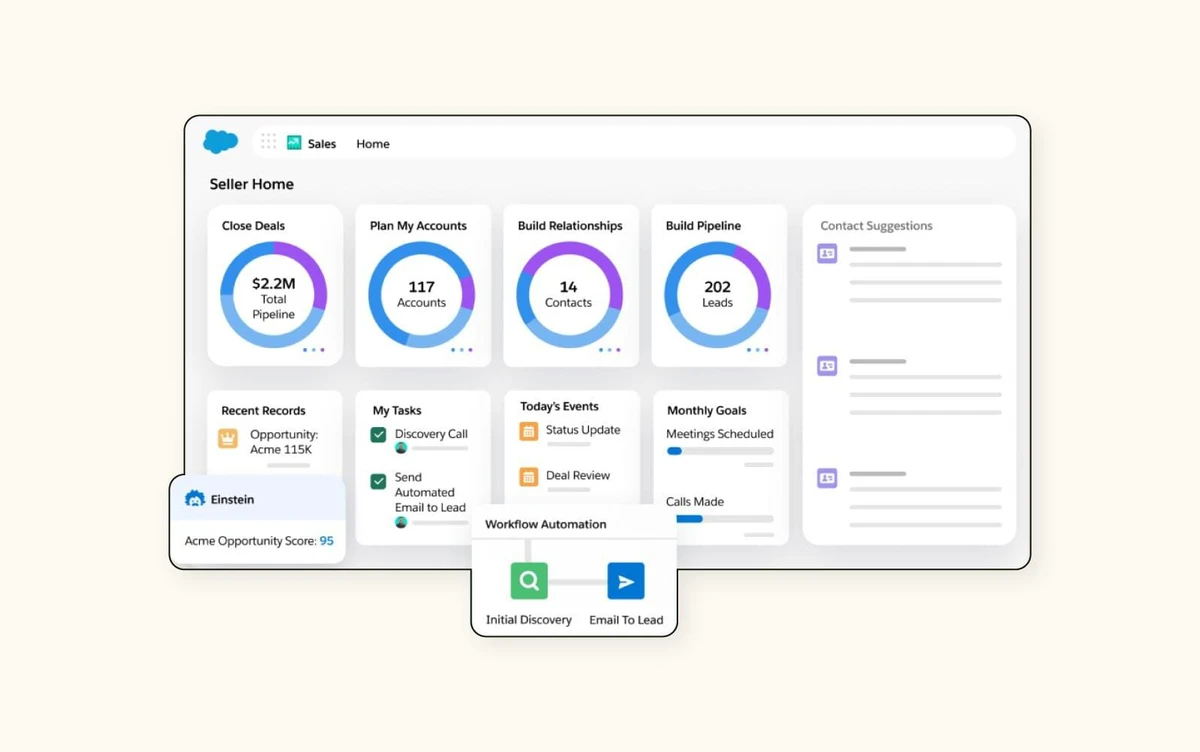
Salesforce Starter provides a $25 USD per user/month entry tier aimed directly at small businesses that anticipate substantial multi-year scaling. Rather than requiring complex custom configuration, the Starter suite prepackages core sales pipeline stages, email marketing cadences, and customer support ticketing inside a simplified interface. This setup grants founders immediate access to the broader Salesforce reporting ecosystem without the administrative overhead historically associated with enterprise deployments.
Agile CRM: Best Budget-Friendly Free Tier for Small Teams
Agile CRM delivers one of the most generous free packages on the market, supporting up to 10 users, 1,000 contact records, and 5,000 branded marketing emails. The platform includes web engagement tracking, contact scheduling, custom fields, and an integrated form builder, giving lean teams an all-in-one platform for lead capture and deal management without upfront capital commitments. For businesses where deal closing transitions immediately into client fulfillment, tools like monday.com bridge sales pipelines directly to operational project boards to ensure smooth post-sale handoffs.
Hidden Costs, Admin Overhead, and Upgrade Traps
Data published by Salesforce reveals that the average organization maintains nearly 900 separate software applications across its operational stack. When these systems operate without seamless integration, employees are forced to manually transfer information between disconnected software, generating operational errors and misplacing client updates. Furthermore, 82% of businesses report that system integration represents one of their biggest AI challenges.
Warning: Low entry pricing often conceals steep mid-tier escalations. Small businesses frequently face unbudgeted expenses when vendor pricing structures impose mandatory onboarding packages, strict API call thresholds, or steep per-contact storage penalties as databases exceed basic contact ceilings.
To avoid recurring budget overruns, small business evaluators must scrutinize several operational risk areas before executing vendor agreements:
- Telecom Compliance and Message Filtering: Deploying automated SMS outreach or integrated dialers within the United States requires navigating A2P 10DLC registration, Campaign Registry verification fees, and strict TCPA opt-in rules. Solutions lacking built-in registration workflows force teams to configure complex third-party telephony accounts, risking severe carrier filtering on customer communications.
- Accounting and Tax Reconciliation: CRM platforms that do not maintain verified, two-way synchronization with external accounting systems create invoice reconciliation backlogs, duplicate transaction records, and sales tax reporting errors.
- State Privacy and Data Extraction: Under state privacy legislation such as the California Consumer Privacy Act (CCPA), businesses must fulfill consumer data deletion requests promptly. Platforms without built-in compliance logs or simple data deletion workflows force staff to purge records manually across disparate modules.
- Relational Data Portability: Many low-cost platforms allow simple CSV contact exports but lock down activity timelines, custom interaction histories, and notes, making future software migrations costly and destructive.
- Workflow Routing Errors: Expanding automation rules without standardized data structures creates circular routing loops and lead scoring errors, confusing sales representatives and dropping prospective buyers.
Why Small CRM Rollouts Fail and How to Drive Adoption
Most CRM implementations fail due to poor user adoption rather than technical limitations. Early-stage teams succeed by rejecting feature bloat, standardizing key fields and tags, and deploying narrow, high-value automations that demonstrably save sales representatives time within the first 30 to 90 days.
Industry analyst Brad Beumer documented this exact failure dynamic, observing:
“It is now well-known and researched that most CRM projects fail because of low-to-no user adoption.”
When leadership implements software without consulting frontline sales staff, team members view the database as a managerial surveillance tool rather than an administrative aid, leading to abandoned records and unlogged phone calls. Achieving consistent team adoption requires executing proven change management practices:
- Identify Internal Champions: Appoint a respected sales representative or account executive to pilot the platform, gather early workflow feedback, and train colleagues.
- Standardize Fields and Picklists: Restrict custom data entry fields to essential deal attributes. Eliminating free-form text boxes in favor of structured drop-down menus maintains clean database sorting.
- Implement Contact Deduplication: Clean and deduplicate imported contact sheets prior to initial pipeline routing so sales reps trust lead assignment data.
- Deploy Immediate Time-Savers: Focus early automation strictly on eliminating manual drudgery, such as automated meeting scheduling, instant call logging, and one-click quote generation.
How to Choose the Right CRM for Your Business
A disciplined selection process evaluates concrete business requirements rather than marketing feature lists. Cloudswave research indicates that proper CRM implementation increases sales conversion rates by up to 300%, while analysis from Capterra demonstrates a 47% boost in customer retention metrics. Realizing these returns requires matching software complexity directly to team capacity.
K.C Watson, CEO and founder of Sherpa, noted the direct operational impact of adopting structured software:
“We attribute this to Zoho – being organized, getting more visibility, seeing where the problem points are, and restructuring our business.”
Small business decision-makers should follow these operational selection guidelines:
- Solo Operators and Micro-Teams (1–3 users): Choose Bigin by Zoho or Agile CRM. These platforms offer zero-cost or low-dollar tiers that deploy within hours without ongoing administrative maintenance.
- Deal-Focused Sales Teams (4–15 users): Choose Pipedrive or Zoho CRM. These platforms centralize visual pipelines, streamline stage velocity, and provide clear activity-based accountability.
- Content and Inbound-Driven Businesses: Select HubSpot to capture website leads, automate marketing follow-ups, and track contact engagement from a centralized dashboard.
- High-Velocity Startups Preparing for Scale: Deploy Salesforce Starter to establish standardized operational data models and customer history tracking before expanding headcount.
FAQ
What is the most affordable CRM for a US micro-business or sole proprietorship?
Bigin by Zoho offers an entry-level free tier for single users and caps paid plans at $21 USD per user per month while including HIPAA compliance. Agile CRM also provides a zero-cost tier supporting up to 10 users, 1,000 contacts, and 5,000 branded emails monthly.
How much ROI can a small business realistically expect from a CRM?
Nucleus Research documented an average return of $8.71 for every dollar spent on CRM systems. Studies compiled by Cloudswave and Capterra indicate that successful adoption drives lead conversion rate increases of up to 300% and improves customer retention rates by 47% across sales teams.
Can small businesses handle sensitive client data on entry-level CRMs?
Yes. Both Bigin and Zoho CRM include native GDPR and HIPAA compliance controls directly out of the box. These configurations allow medical practices, financial service providers, and legal consultancies in the United States to manage sensitive client interaction records securely without paying for custom enterprise compliance addons.
What is the primary reason small business CRM implementations fail?
Industry specialist Brad Beumer notes that implementation failure stems primarily from poor user adoption rather than technical system deficits. Projects collapse when leaders impose bloated data-entry requirements instead of rolling out focused, time-saving automations that provide tangible administrative relief to frontline sales staff within 30 to 90 days.