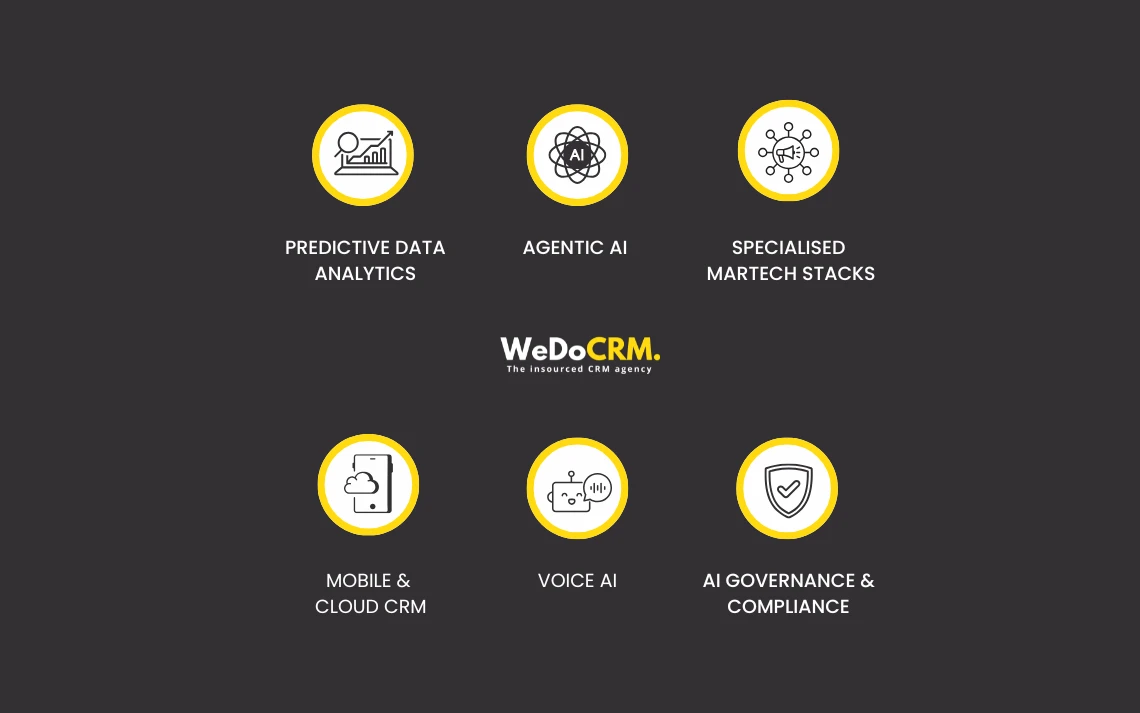
CRM in 2026 is no longer defined as a passive database for manual activity tracking; it is evolving into an active execution engine powered by task-specific autonomous agents and decoupled enterprise data architectures. As organizations move past pilot generative AI deployments, the competitive benchmark shifts from storing historical records to orchestrating predictive, real-time actions across sales, marketing, and customer service workflows. Research from Gartner projects that by the end of 2026, 40% of enterprise applications will include task-specific AI agents, while over 80% of enterprises will run generative AI in production environments. Successfully capturing this architectural transition requires enterprise technology buyers, RevOps leaders, and IT architects to move beyond experimental chatbots, address structural data deficits, and implement rigorous operational governance.
How Autonomous Agents Turn CRM into a System of Action
In 2026, CRM is shifting from a passive system of record into an autonomous system of action. Rather than merely logging interactions, task-specific AI agents analyze behavioral signals, anticipate customer churn, execute workflows, and conduct multi-step outreach without constant human prompting, drastically accelerating speed-to-lead and routine case resolutions.
Traditional customer relationship management relied on reactive, trigger-based automations configured around rigid conditional logic. If an inbound prospect submitted a web form, the platform assigned a record and distributed a notification; if an account remained dormant for thirty days, it flagged a task for a human representative. Autonomous CRM agents in 2026 replace these static pathways with dynamic reasoning loops. Rather than executing a single predetermined step, an agent evaluates customer behavior, synthesizes previous interactions across email and voice channels, identifies potential deal risks, and initiates targeted remediation independently.
Industry analyst Neil Ward-Dutton of IDC defined the strategic imperative of this evolution:
“Organizations that rethink CRM as a real-time, AI-powered system of action — and embrace agentic AI to handle complex, unpredictable work — are better positioned to deliver exceptional customer experiences”
Operational data demonstrates that transitioning from static record-keeping to autonomous action delivers measurable efficiency gains across enterprise teams:
- Resolution Acceleration: Organizations deploying AI agents within customer service workflows report a significant reduction in average resolution times for routine cases.
- Capacity Recovery: Contact center agents save valuable time each day by offloading preliminary diagnostic research, administrative record updates, and meeting summaries to autonomous systems.
- Proactive Engagement Impact: Organizations implementing agent-driven proactive customer outreach register a substantial improvement in customer satisfaction scores compared to traditional reactive support models.
By resolving high-volume, repetitive tasks autonomously, agentic CRM environments allow human sales representatives and customer success managers to concentrate their efforts on complex strategic negotiations and high-touch relationship management.
The Enterprise Battle for the Central Data Layer
Enterprise IT architects in 2026 are systematically dismantling the proprietary data silos historically enforced by legacy CRM platforms. For decades, major enterprise software vendors required organizations to replicate customer information into proprietary database schemas, creating substantial operational lock-in and synchronization latency. That monolithic model is being disrupted as cloud data warehouses and lakehouses establish themselves as the definitive single source of truth for all enterprise operations.
Industry analyst Datwani highlighted the competitive friction surrounding this architectural shift:
“Everyone is battling for that data layer”
To resolve this conflict, organizations are adopting zero-copy architectures powered by centralized data platforms such as Snowflake and Databricks. Rather than moving, duplicating, and transforming sensitive customer records into an external CRM database, modern CRM interfaces connect directly to the central cloud warehouse via high-speed, bi-directional synchronization layers. This decoupling transforms the CRM into a modular presentation and workflow layer, while centralized repositories retain complete control over identity resolution, row-level security, and regulatory compliance. An analysis published by 4CRMs captured this operational reality:
“Modular CRM ecosystems beat all-in-one platforms.”
The financial dividends of this modular approach are substantial. Empirical industry data shows that organizations operating integrated, connected systems achieve 35% annual recurring revenue growth, compared to 19% growth for businesses relying on isolated standalone CRM platforms. Connected systems also attain a 95% net revenue retention rate by unifying billing data, product usage metrics, and support history across customer-facing departments.
The following comparison illustrates the functional differences between legacy monolithic architectures and the decoupled composable environments defining 2026 enterprise standards.
Architectural Dimension |
Legacy Monolithic CRM |
2026 Composable & Agentic CRM |
|---|---|---|
Data Layer Ownership |
Proprietary vendor silos requiring repetitive ETL data duplication and sync scripts. |
Zero-copy lakehouse architectures powered by Databricks bi-directional sync. |
Operational Execution |
Passive system of record reliant on manual seller data entry and basic trigger rules. |
Autonomous system of action utilizing task-specific AI agents executing multi-step workflows. |
Commercial Licensing |
Rigid per-user seat subscriptions that penalize organizational scaling and automation. |
Consumption-based token pools, outcome-linked tiers, and autonomous digital worker pricing. |
Ecosystem Extensibility |
Walled-garden app exchanges with heavy proprietary API integration dependencies. |
Modular, API-first headless interfaces connected across unified enterprise iPaaS fabrics. |
Revenue Performance |
Averages 19% ARR growth due to fragmented customer visibility across business units. |
Drives 35% ARR growth and 95% net revenue retention through real-time cross-functional synchronization. |
By separating data storage from operational tooling, enterprise technology leaders insulate their infrastructure from vendor dependencies while maintaining strict governance standards across all customer touchpoints.
The Dirty Data Paradox Threatening AI Deployments
The primary barrier to CRM AI adoption in 2026 is data quality: while 90% of buyers prioritize AI-powered platforms, 76% of organizations report less than half of their CRM data is accurate. Without rigorous automated enrichment, corrupted records cause severe seller errors and render advanced AI models ineffective.
Executive enthusiasm for autonomous technology contrasts sharply with underlying technical readiness. Implementation research from Matech Co and benchmarks compiled by Johnny Grow reveal that 70% of enterprise CRM implementations fail to meet their intended business goals. The primary cause of this systemic underperformance is fragmented, unstandardized, and outdated data. While software buyers seek competitive advantage through automation, 45% of organizations acknowledge that their internal CRM databases are not prepared to support AI features. Autonomous agents trained on inconsistent schemas and duplicate contacts inevitably hallucinate, misroute sales leads, and misjudge account health.
Remediating this dirty data paradox requires continuous, automated data hygiene protocols integrated directly into ingestion pipelines rather than occasional manual cleanups. RevOps teams preparing for agentic deployments must execute a structured 30-day data triage protocol:
- Automated Deduplication and Record Merging: Run algorithmic entity-resolution scripts to identify matching company domains, consolidate conflicting account hierarchies, and merge duplicated contact records across historical databases.
- Continuous Third-Party Verification: Integrate automated enrichment layers to verify email deliverability, validate current executive titles, and standardize industry taxonomy before feeding data into AI context windows.
- Cross-Repository Identity Harmonization: Reconcile customer identifiers across ERP billing systems, customer service ticketing platforms, and marketing automation databases to eradicate orphan records.
- Ingestion Governance Gates: Enforce strict validation rules at every point of entry, blocking unformatted inputs and incomplete records from polluting the central data foundation.
A Decision Framework for Governing Agent Autonomy
Autonomous agents introduce significant operational exposure when granted unconstrained execution authority across enterprise systems. Technology research firm Gartner forecasts that over 40% of agentic AI implementations will be canceled by the end of 2027 due to escalating token costs, unclear business value, and inadequate risk controls. When an unmonitored agent hallucinated incorrect discount schedules, violates contractual commitments, or leaks confidential account metrics across customer boundaries, organizations face direct legal and financial consequences.
To mitigate these deployment risks, IT architects and RevOps leaders must implement an operational governance framework that establishes explicit boundaries between automated execution and mandatory human authorization. Enterprise workflows should be mapped across a four-tier risk classification structure:
- Tier 1 — Full Autonomy (Low Risk): Background operational tasks, including internal field categorization, account enrichment, transcription processing, and automated calendar logging. Agents execute actions independently without human intervention.
- Tier 2 — Supervised Automation (Moderate Risk): Operational workflows such as automated speed-to-lead distribution, standard email replies adhering to validated playbooks, and task routing. Actions proceed automatically while writing complete audit rationales to an asynchronous supervisory log.
- Tier 3 — Human-in-the-Loop Sign-Off (High Risk): High-impact sales actions, including customized pricing quotes, discount tier approvals, and contract draft generation. The agent analyzes customer parameters, verifies margins, and drafts terms, but requires explicit human approval before external communication.
- Tier 4 — Prohibited Autonomy (Critical Risk): Legally binding obligations, customized service-level commitments, security privilege modifications, and permanent data deletions. Autonomous execution is strictly blocked at the API gateway layer.
Operational governance also requires technical circuit breakers and continuous surveillance protocols. If an agent encounters adversarial prompt injection attempts, detects contradictory user permissions across siloed enterprise databases, or experiences anomalous token consumption velocity, the circuit breaker trips and suspends execution immediately. Role-based access control (RBAC) and row-level database security must be enforced across all agentic API connections, ensuring autonomous tools operate exclusively within the precise data permissions assigned to the requesting user.
Why CRM Pricing Is Shifting Away from Seat Licenses
The proliferation of autonomous digital workers is disrupting the traditional per-seat licensing model that has governed enterprise software for a quarter of a century. When autonomous agents conduct prospect research, handle Tier 1 support tickets, and update pipeline stages without human involvement, pricing software based solely on the number of human logins becomes obsolete. Commercial forecasts indicate that global CRM software revenue will reach £80.60 billion (about $108.2 billion) in 2026, with corporate spend averaging £21.45 (about $29) per employee. With 61% of enterprise business leaders planning to increase spending on customer experience and artificial intelligence initiatives, software vendors are introducing alternative pricing mechanisms designed to capture the value delivered by autonomous digital agents.
Enterprise software procurement in 2026 is moving toward three alternative billing structures:
- Consumption-Based Token Pools: Organizations purchase shared computation and model query credits that deplete as agents execute context retrievals, plan multi-step actions, and generate external communications.
- Specialized Digital Worker Tiers: Software vendors license autonomous agents as digital workers with defined job functions and monthly workload capacities, billed as specialized software units rather than individual user seats.
- Outcome-Linked Commercial Models: Contracts tie software expenditures directly to validated operational achievements, including verified sales meetings scheduled, high-intent opportunities delivered, or support cases successfully resolved without human escalation.
This structural change requires finance and RevOps leaders to implement dedicated FinOps frameworks for customer relationship management software. Finance teams can no longer project software expenditure solely by tracking employee headcount additions. RevOps leaders must establish monthly token consumption ceilings, configure automated alerts when departments reach 80% of budgeted agent capacity, and continuously audit query efficiency to prevent unforecasted expenses.
Shared Digital Workspaces and Voice-Driven Workflows
Enterprise revenue execution in 2026 is moving beyond traditional dashboard navigation and manual form completion. Complex enterprise procurement initiatives now routinely involve buying committees consisting of six to ten distinct stakeholders across finance, security, IT, and business operations. In response, enterprise revenue teams are adopting collaborative digital workspaces and multimodal interfaces that streamline buyer engagement while automating internal record management.
Collaborative Digital Deal Rooms Replacing Static Email Threads
Projections from Gartner indicate that by the end of 2026, over 80% of enterprise sales cycles will incorporate at least one shared digital workspace. These collaborative deal rooms replace chaotic email chains and scattered document attachments with a centralized digital portal. Buyers and sellers collaboratively review project milestones, access mutual action plans, verify compliance certifications, and track contract revisions in a shared environment. Because these workspaces synchronize directly with the underlying CRM infrastructure, revenue teams gain immediate visibility into buyer intent signals. Furthermore, combining CRM intelligence with connected lead generation and buyer engagement platforms drives average conversion rates to 52%, compared to 34% for isolated CRM software operating without integrated engagement tools.
Voice-Activated Logging and No-Code Agent Configuration
Multimodal interfaces and edge computing are transforming daily frontline sales productivity. Rather than spending valuable selling hours typing post-meeting administrative updates into desktop forms, traveling sales representatives use voice-activated conversational interfaces on mobile devices. Quantized small language models running directly on local edge hardware process natural language speech, extract action items, and update CRM pipeline stages without requiring persistent, high-bandwidth cloud connectivity. This voice-first architecture also supports enterprise compliance with modern digital accessibility standards, including WCAG 2.2 and the European Accessibility Act, by providing accessible interaction options for representatives with diverse physical and cognitive needs.
Simultaneously, visual no-code configuration platforms and agent marketplaces are eliminating development bottlenecks for RevOps personnel. Solutions like Pipedrive provide built-in AI Sales Assistants that deliver automated pipeline guidance, while providers such as Rox deliver agentic platforms capable of autonomous task execution and rapid lead routing. Business analysts can install pre-configured agents, adjust operational rules, and establish routing triggers through visual drag-and-drop interfaces without waiting for IT engineering sprints. Supplying sales teams with sanctioned, low-code automation tools also curtails the growth of shadow AI, preventing employees from using unapproved personal browser extensions that risk exposing sensitive corporate information.
FAQ
What happens when an autonomous CRM agent makes a mistake?
Enterprise deployments implement multi-tiered circuit breakers and continuous surveillance protocols. When an agent experiences prompt anomalies or attempts unapproved pipeline changes, execution halts automatically. High-risk transactions—including custom contractual terms, pricing modifications, and SLA commitments—require mandatory human sign-off before transmission, eliminating external legal and financial exposure.
Why are over 40% of agentic AI CRM initiatives projected to be canceled?
Gartner forecasts that over 40% of agentic AI implementations will face cancellation by late 2027 due to escalating token infrastructure costs, unproven return on investment, and inadequate governance controls. Many organizations deploy autonomous agents atop inaccurate historical data, compounding errors and producing unreliable outputs that erode executive confidence.
How does data decoupling affect traditional CRM vendors?
As enterprises establish cloud data warehouses like Snowflake and Databricks as their centralized single source of truth, traditional CRM systems lose their data monopoly. CRMs increasingly function as modular operational front-ends and workflow execution engines, querying unified repositories via zero-copy architectures rather than maintaining isolated, proprietary data silos.
How will outcome-based CRM pricing impact annual software budgeting?
RevOps and finance leaders must shift from fixed per-seat headcount forecasting to usage and outcome-based financial modeling. Organizations must implement disciplined FinOps frameworks, establishing hard monthly token spend caps, tracking automated task resolution metrics, and auditing API consumption to avoid unpredictable operational expenses across vendor contracts.
Conversions use a rate of 1 GBP = $1.34 as of November 11, 2026; rates may change.